


TalentLMS Case Study
Beyond Compliance: Accessible eLearning
A Few Words
- TalentLMS is a leading learning management system (LMS) used by organizations worldwide to train employees, customers, and partners. For a platform people depend on to learn and grow, accessibility is central.
- As accessibility became a strategic priority, TalentLMS set out to work systematically towards accessibility compliance with the Web Content Accessibility Guidelines (WCAG), without slowing down its rapid pace of product development.
- The challenge went beyond simple compliance. TalentLMS needed a clear way to prioritize barriers, fix them within existing workflows, and make sure the improvements worked for real users.
- TalentLMS partnered with theUXProdigy for expert guidance across the full accessibility journey: understanding accessibility requirements and setting goals, rounds of expert audits, hands-on remediation support, and moderated usability testing with people with disabilities.
- The result: 83 accessibility issues resolved, a successfully completed compliance process, and product, design, engineering & QA teams that now treat accessibility as a shared, everyday responsibility.
The Objective
Set up a systematic workflow towards accessibility compliance, and make accessibility part of the product.
Learning is only inclusive if everyone can take part. Learners using screen readers, keyboard-only navigation, captions, or other assistive technologies need to enroll, follow a course, complete an assessment, and track their progress as independently as anyone else. The same applies to administrators and instructors who build courses and manage users. (Note: this first wave of work focused on the learner role).
TalentLMS recognized this and made accessibility a strategic priority. The team wanted to identify and remediate accessibility issues and work consistently toward compliance, but with an important condition: accessibility had to become integral to how the product is built, not a one-off project that fades once the certificate is issued.
That ambition came with real constraints. TalentLMS is a large, actively evolving platform, and the team ships continuously. Remediation had to fit alongside the roadmap, not stall it. It also required close collaboration among product, design, engineering, and QA, each owning a piece of the solution. TalentLMS needed a partner who could:
- Evaluate the platform rigorously against WCAG requirements and usability specifications.
- Identify, analyze, and prioritize barriers by user impact and development effort
- Guide remediation through multiple review cycles
- Validate improvements through both expert evaluation and testing with real users
- Leave the team with the knowledge and processes to maintain accessibility in the long term.
The Solution
A structured, collaborative path towards compliance and accessible learning experiences.
theUXProdigy supported TalentLMS from analyzing goals and gathering requirements through to the successful completion of the compliance process according to the 8-stage model. Rather than handing over a report and stepping back, our team worked alongside TalentLMS’s product, design, engineering, and QA teams at every stage.
Round 1: Expert accessibility audit
The journey began with a comprehensive audit combining automated testing with manual evaluation by accessibility experts. Automated tools are efficient at catching certain issues, but many barriers, such as keyboard traps, unclear focus order, missing context for screen reader users, and problematic interaction patterns, only surface through hands-on expert review.
We documented every finding, mapped it to the relevant WCAG success criteria, and prioritized it, giving TalentLMS a clear, actionable picture of where to start.
Remediation and collaboration (after every round of audit and usability testing)
Next came the work that determines whether an audit leads to real change. Our team partnered with TalentLMS’s product, design, engineering, and QA teams to provide practical guidance as they designed and built fixes. We reviewed implementations, answered questions as they came up, and helped the team sequence improvements based on user impact and development effort, so progress kept pace with the product roadmap.
By integrating the guidance into existing workflows rather than layering it on top, accessibility fixes became part of regular delivery instead of a disruptive side project.
Round 2: Expert accessibility audit
Once we addressed the first wave of issues, we conducted a second expert audit. Its purpose was to verify that fixes were implemented correctly, uncover any remaining or newly introduced barriers, and confirm that the platform was moving toward compliance with the applicable requirements.
Round 3: Usability testing with people with disabilities
Conformance with WCAG is essential, but it does not guarantee that a product is easy to use. To close that gap, we ran moderated usability testing with people with disabilities and observed them as they completed realistic tasks on the platform.
These sessions revealed friction that audits and automated tools cannot detect on their own, and we gave the TalentLMS team first-hand insight into how people actually experience their platform. The findings highlighted further opportunities to improve usability, beyond what compliance alone requires.
Accessibility documentation
Alongside the systematic work following the UXProdigy model, we delivered the appropriate accessibility documentation, such as an Accessibility Statement and VPAT.
Results
Compliance achieved, and a team equipped to sustain it.
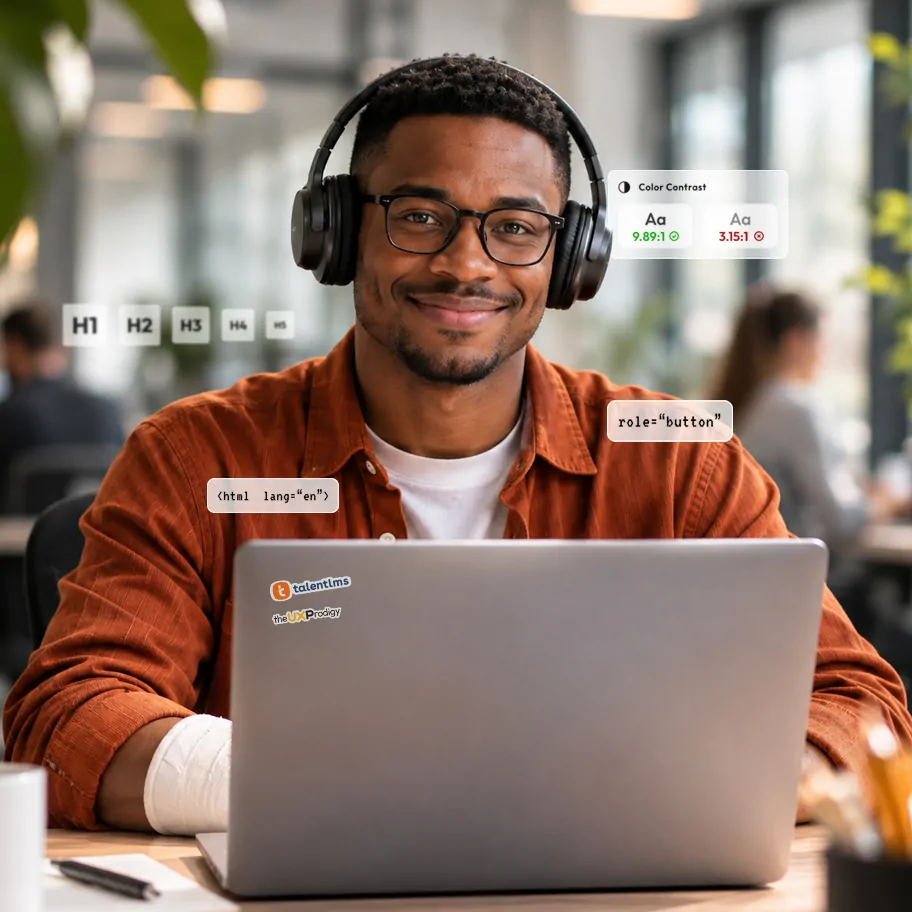
A more inclusive learning experience
The improvements made during the compliance process significantly enhanced the experience for users with visual, motor, and cognitive disabilities. Many of these changes, such as clearer structure, better keyboard support, and more consistent interaction patterns, also make the platform easier to use for everyone, whatever their device, environment or abilities.
An accessibility practice that lasts
One of the most valuable outcomes goes beyond compliance. Throughout the project, we embedded accessibility knowledge into TalentLMS’s existing development practices. Designers, developers, QA engineers, and product managers gained practical, hands-on experience, so they can now anticipate accessibility needs earlier and build them into future releases from the start.
Accessibility is no longer treated as a final compliance checkpoint. It has become a shared responsibility across teams, and part of everyday decision-making. That shift keeps the platform on track to deliver accessible learning experiences as it continues to grow.
“The project’s real impact is the cultural shift it has created in our team. By embracing an accessibility-by-design approach, our teams are changing how they think, collaborate, and build products—making accessibility an integral part of delivering better learning experiences for everyone.”
Andrea Lorenzon, CTO


